Our Accountability

Transparency and integrity are at the heart of everything we do. Explore our policies, guidelines, and compliance documents below.

1. Purpose
This policy establishes the governance and management framework of Dreamland Development Foundation (DDF) to ensure transparency, accountability, effectiveness, and compliance with Myanmar laws and international organizations.

2. Scope
This policy applies to the Board of Directors, Executive Management, staff, volunteers, and representatives of Dreamland Development Foundation.

3. Governance Principles
Dreamland Development Foundation is governed according to the principles of:
 Accountability to affected populations, donors, and stakeholders
 Transparency in decision-making and financial management
 Independence, neutrality, non-nepotism and non-partisanship
 Inclusion, gender equality, and respect for diversity
 Zero tolerance for corruption, fraud, abuse, or exploitation

4. Organizational Structure
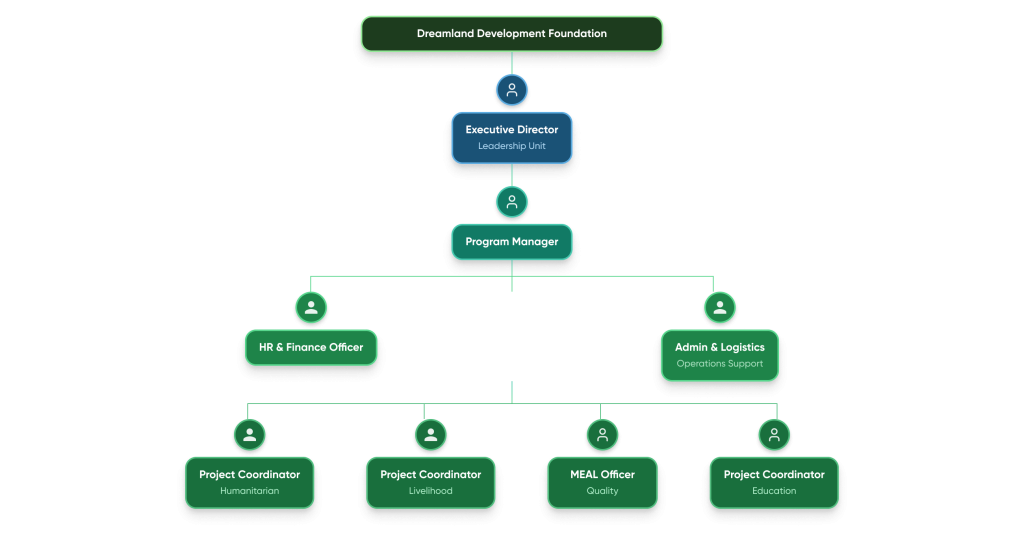
Board of Directors (BoD):Highest governing authority
 Executive Director (ED): Chief executive responsible for operations
 Management Team: Program Manager, head of management and administrative leadership
 Support Functions: Finance, HR, Administration, Compliance

5. Roles & Responsibilities
Board of Directors

 Approves strategic plans, budgets, and institutional policies
 Ensures fiduciary oversight and legal compliance
 Appoints, supports, and evaluates the Executive Director

Executive Director
 Implements Board-approved strategies and policies
 Oversees programs, finance, HR, and compliance Represents DDF with donors and authorities

6. Decision-Making & Delegation
Authority is delegated through written delegation matrices. Financial and procurement decisions follow approved thresholds.

7. Conflict of Interest
All Board members and staff (This includes full or part time, volunteers and consultant) must declare actual or perceived conflicts of interest and recuse themselves from related decisions.

8. Review & Approval
This policy is approved by the Board and reviewed every three years or as required.
This Code of Conduct sets out the principles, values, and standards of behavior expected from everyone representing Dreamland Development Foundation (DDF), including board members, advisory members, executive body, resource pool members, staff, volunteers, consultants, partner organizations, and any other individuals or entities working with DDF.

1. Professionalism and Community Well-being
Dreamland Development Foundation expects its all affliate memebers to uphold the highest standards of professionalism, integrity, and care, and to contribute to a safe, positive, and healthy environment for all. All members must conduct themselves in a manner that enables community members to fully enjoy and benefit from DDF’s programs and activities.

2. Integrity and Organizational Reputation
Members are expected to preserve and enhance the integrity, credibility, and reputation of DDF through their actions and decisions. Personal and professional behaviour must align with the Foundation’s mission, vision, and core values at all times, including when acting as ambassadors of DDF in public or online spaces.

3. Respect, Diversity, and Inclusion
DDF celebrates multiculturalism and diversity and is committed to an environment free from discrimination, bullying, or harassment. All individuals must treat others with dignity and respect, without discrimination based on ethnicity, religion, gender, gender identity, age, disability, language, socioeconomic status, sexual orientation, or any other personal characteristic.

4. Conflict of Interest
All members must avoid actual, potential, or perceived conflicts of interest in performing their duties for DDF. Any situation that could compromise, or appear to compromise, impartial judgment must be disclosed promptly to the appropriate DDF authority, and appropriate steps taken to manage or remove the conflict.

5. Commitment to Ethical Practice and Accountability
The expectations set forth in this Code are supported by DDF’s internal policies and procedures, especially those protecting underprivileged and marginalized populations. Members must act honestly, transparently, and responsibly in all dealings, use organizational resources prudently, and accept that breaches of this Code may lead to corrective or disciplinary measures.

6. Confidentiality and Data Protection
Members must safeguard confidential and sensitive information obtained through their association with DDF. Such information, including personal data of community members, partners, and colleagues, must only be accessed, used, or shared when necessary for legitimate organizational purposes and in line with applicable data protection laws and DDF policies.

7. Integrity in Communication and Representation
All communications on behalf of DDF, whether written, verbal, or online, must be accurate, respectful, and consistent with the Foundation’s mission and values. Only individuals with appropriate authority may speak or publish in DDF’s name, and they must avoid misleading statements or unsubstantiated claims about the Foundation’s work, partners, or impact.

8. Health, Safety, Safeguarding, and Environmental Responsibility
DDF is committed to ensuring the safety and protection of children, youth, and vulnerable adults, as well as the health and safety of all staff and community members. All members must follow safeguarding, safety, and security procedures, promptly report any risk or incident, and support environmentally responsible practices that reflect DDF’s concern for sustainable development.

9. Use of Resources and Asset Protection
Members must use DDF’s financial, material, digital, and intellectual resources responsibly and only for legitimate organizational purposes. Misuse, abuse, fraud, or waste of resources is strictly prohibited and may result in disciplinary or legal action.

10. Substance Use and Professional Boundaries
While engaged in DDF activities, members must not be under the influence of illegal drugs or alcohol, nor engage in behaviour that impairs judgment, safety, or professionalism. Professional boundaries with beneficiaries, colleagues, and partners must be maintained at all times, avoiding any form of exploitation, abuse, or favoritism.

11. Reporting Misconduct and Protection from Retaliation
DDF encourages all members to promptly raise concerns regarding any suspected violation of this Code, organizational policies, or applicable laws. Good-faith reports made through designated channels will be treated seriously, fairly, and, where possible, confidentially, and DDF strictly prohibits retaliation against any person who reports or cooperates in an investigation.
1. Purpose
This policy establishes Dreamland Development Foundation’s framework for Monitoring, Evaluation, Accountability, Learning (MEAL), and legal compliance to ensure effective, transparent, and lawful programming aligned with Myanmar regulations and international donor requirements.

2. Scope
This policy applies to all Dreamland Development Foundation programs, projects, staff, partners, and operations.

3. MEAL Principles Dreamland Development Foundation’s MEAL system is guided by:
 · Resultsbased management
 · Accountability to affected populations
 · Learning and continuous improvement
 · Transparency and evidencebased decisionmaking

4. Monitoring & Evaluation
Dreamland Development Foundation commits to:
 · Defining clear indicators and targets
 · Monitoring outputs, outcomes, and risks
 · Conducting internal and external evaluations as required by donors

5. Accountability to Affected Populations (AAP)
Dreamland Development Foundation ensures:
 · Timely and accessible information sharing
 · Safe feedback and complaints mechanisms
 · Participation of communities in program design and review Feedback is used to improve program quality and relevance.

6. Learning & Knowledge Management Lessons learned are documented and integrated into planning, training, and program adaptation.

7. Legal & Regulatory Compliance
Dreamland Development Foundation complies with:
 · Myanmar laws and regulations applicable to NGOs
 · Registration, reporting, and tax obligations
 · Donor contractual and compliance requirements

8. Risk Management & Compliance Oversight
The Board and management oversee:
 · Compliance risks
 · Donor conditions
 · Ethical and legal obligations

9. Documentation & Reporting
Dreamland Development Foundation maintains accurate programmatic, financial, and compliance records for audits and donor reviews.

10. Review & Approval
Approved by: Board of Directors, Dreamland Development Foundation
Effective Date: 1. 1. 2026

Review Cycle: Every 3 years or upon donor or legal requirement
Dreamland Development Foundation adopts a zero-tolerance approach to all forms of sexual exploitation, sexual abuse, and sexual harassment (SEA). This policy ensures the safety, dignity, and rights of all beneficiaries, staff, volunteers, partners, and community members we serve.

1. Purpose
This PSEAH Policy aims to prevent, detect, and respond to any sexual misconduct by DDF personnel or associated parties, protecting vulnerable populations—particularly women, children, and marginalized groups—from exploitation and abuse.

2. Scope
This policy applies to:
 All DDF Board members, staff, volunteers, consultants, contractors, interns, and trainees.
 Partner organizations, implementing partners, sub-grantees, and suppliers under DDF contracts.
 Any individual or entity acting on behalf of or representing DDF in programs or operations.

3. Core Principles (IASC Standards)
DDF upholds the six core principles for humanitarian agencies:
 1.Sexual exploitation and abuse by employees constitute acts of gross misconduct and are grounds for termination.
 2.Sexual activity with children (under 18) is prohibited regardless of local age of consent. Mistaken age belief is not a defense.
 3.Exchanges of money, goods, or favors for sex are prohibited, including trafficking.
 4.Any abuse of power or authority for sexual purposes is prohibited.
 5.Humanitarian workers must report any SEA violations by colleagues or partners.
 6.Managers must create environments preventing SEA and enforcing this Code.

4. Definitions
 Sexual Abuse: Actual or threatened physical intrusion of a sexual nature (rape, sexual assault, attempted assault).
 Sexual Exploitation: Misuse of power or position to induce sexual activity through abuse of authority, coercion, or bribery.
 Sexual Harassment: Unwelcome sexual advances, requests for favors, or verbal/physical conduct of a sexual nature.
 Child: Anyone under 18 years of age.

5. Prohibited Behaviors
The following are strictly forbidden:
 Any sexual interaction with program beneficiaries or community members.
 Sexual relationships between staff and beneficiaries, regardless of consent.
 Using DDF resources (money, food, positions) to obtain sexual favors.
 Sexual contact with minors under 18.
 Retaliation against reporters of SEA incidents.
 Failing to report known or suspected SEA.

6. Prevention Measures
Dreamland Development Foundation will:
 Conduct mandatory PSEAH training during onboarding and annually.
 Perform due diligence and PSEAH clauses in all partner agreements.
 Display PSEAH posters, hotlines, and reporting info at all program sites.
 Map risks during project design and monitor high-risk contexts.
 Promote gender balance and leadership accountability for PSEAH.

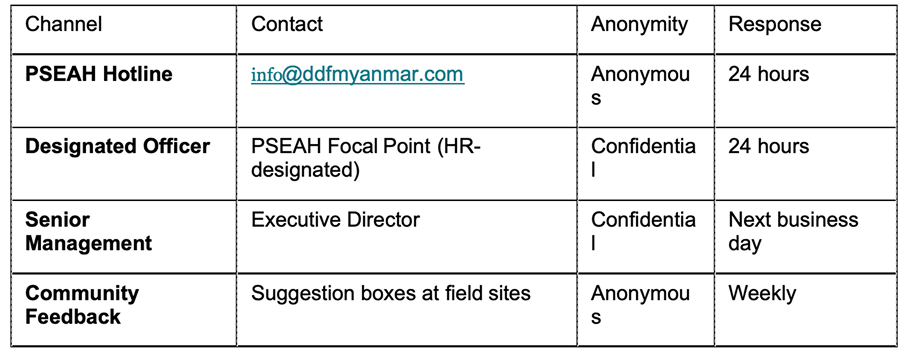
7. Reporting Mechanism
All suspected SEA must be reported immediately through confidential, safe channels:
· External: Myanmar Anti-Corruption Commission or local police if unsafe to report internally.
· What to Report: Who, what, when, where, evidence (do not investigate yourself).
· Protection: No retaliation for good-faith reports. Survivors receive support without prejudice.

8. Response Procedure
  1. Immediate Safety:Secure victim safety; preserve evidence; separate accused from victim/work.
  2. Assessment (24 hrs): PSEAH Focal Point assesses urgency/risk.
  3. Investigation (7-14 days): Impartial internal team or external experts; survivor-centered approach.
  4. Resolution: Disciplinary action, contract termination, legal referral.
  5. Support: Medical, psychosocial, legal aid for survivors; no assumption of staff/beneficiary fault.
  6. Closure: Lessons learned, program adjustments, donor reporting.

9. Roles and Responsibilities
  · Board: Policy oversight, annual review.
  · Executive Director: Ensures implementation, chairs investigations.
  · PSEAH Focal Point: Manages reports, training, partner compliance.
  · Managers: Model behavior, monitor teams, enforce reporting.
  · All Staff: Report violations; uphold standards.

10. Partner Compliance
All partners must:

 · Adopt compatible PSEAH policies.
 · Train staff and cascade to sub-partners.
 · Report SEA incidents affecting DDF programs.

Breach leads to contract suspension/termination.

11. Training and Awareness
 · Mandatory onboarding module (1 hour).
 · Annual refresher for all.
 · Specialized training for field/program staff.
 · Community sensitization sessions.

12. Monitoring and Review
 · Annual audits of PSEAH implementation.
 · Post-incident reviews.
 · Policy updated every 2 years or as needed.
 Effective Date: 1.1. 2026

 Approved by: DDF Board of Directors
1. Purpose
The purpose of this Conflict of Interest Policy is to protect the integrity, credibility, and decision-making processes of Dreamland Development Foundation (DDF) by ensuring that all decisions are made solely in the best interests of the organization, with impartiality and no concentration of power within family units but the communities it serves. It provides guidance for identifying, disclosing, and managing actual, potential, or perceived conflicts of interest involving DDF’s people.

2. Scope
This policy applies to all members of the Board of Directors, advisory members, executive and management staff, employees, volunteers, consultants, interns, and any other individuals or entities acting on behalf of or representing DDF, including key partners and implementing organizations where contractually required.

3. Definition of Conflict of Interest
A conflict of interest arises when an individual’s personal, financial, professional, or other interests could improperly influence, or appear to influence, their judgment, decisions, or actions on behalf of DDF. Conflicts of interest may be:
 Actual: A direct conflict exists between a personal interest and DDF’s interest.
 Potential: A personal interest could develop into a conflict in the future.
 Perceived: A situation could reasonably be seen by others as a conflict, even if no actual conflict exists.
Examples include, but are not limited to:
 Having a financial interest in a supplier, contractor, or grantee that DDF is considering for a contract or partnership.
 Using DDF information, assets, or relationships for personal benefit or for the benefit of a relative, friend, or associated organization.
 Participating in decisions that may benefit an organization where the individual or their close family member serves as a board member, owner, employee, or consultant.
 Accepting gifts, hospitality, or favors that could influence, or be perceived to influence, decisions.

4. General Principles
 All decisions must be made in the best interests of DDF and its beneficiaries.
 Individuals must act with honesty, transparency, and impartiality in all DDF-related activities.
 Conflicts of interest are not, in themselves, misconduct; however, failing to disclose or appropriately manage a conflict is a serious breach of this policy.
 Every board, management and staff must sign a Conflict of Interest Disclosure Form annually, listing all family members employed by the organization or doing business with it.
 Perception matters: individuals should consider how their actions may be viewed by stakeholders, beneficiaries, and the public.

5. Duty to Disclose
All covered persons have a duty to promptly and fully disclose any actual, potential, or perceived conflict of interest as soon as they become aware of it. This includes:
 Disclosing in writing to the relevant line manager, Human Resources, the Executive Director, or the Board Chair (for Board-level matters).
 Completing and updating an annual Conflict of Interest Declaration Form, especially for Board members, senior management, and staff in sensitive roles (e.g., procurement, finance, grants, HR).
 Informing DDF immediately if circumstances change and create a new conflict or alter an existing one.

6. Prohibited Conduct and Restrictions
Where a conflict of interest has been identified, individuals must:
 Not participate in the decision-making process related to the matter in conflict (e.g., abstain from discussions, evaluations, and voting).
 Not attempt to influence others’ decisions on the matter.
 Not access confidential information that is not necessary for their role, particularly where such information could be used for personal or third-party gain.
 No Board member or Management include a spouse of immediate family members of the Executive Director or Finance, it is strictly prohibited from serving the Board.
 No Signatory of a husband and wife or any two family members shall be joint signatories on any bank account or financial instrument of the organization. DDF may impose additional restrictions where necessary, such as reassignment of responsibilities, removal from a project, or termination of a contract.

7. Gifts, Hospitality, and Benefits
To prevent conflicts of interest and reputational risk:
 Staff and representatives of DDF must not solicit gifts or favors in connection with their role.
 Modest, customary, and infrequent gifts or hospitality may be accepted only if they do not create an obligation, expectation, or perception of influence.
 High-value gifts, cash or cash equivalents, and any offer linked to a specific decision or advantage must be politely declined and reported.
 DDF may define a monetary threshold and register for recording gifts and hospitality; staff must follow these internal procedures where they exist.

8. Procurement, Anti-Nepotism in HR and Partner Selection
To ensure fairness and transparency:
 Individuals involved in procurement, contracting, or partner selection must declare any relationship or interest with bidding or potential partner organizations.
 Any person with a conflict regarding a bidder, supplier, consultant, or partner must be excluded from the evaluation and decision-making process for that specific case.
 All procurement and partnership processes must follow DDF’s approved policies and documented criteria, ensuring open and fair competition wherever appropriate.

9. Review and Management of Conflicts
Upon disclosure of an actual, potential, or perceived conflict of interest:
 The relevant manager, HR, Executive Director, or Board Chair (as appropriate) will review the disclosure.
 They may request additional information, discuss the situation with the individual, and determine appropriate mitigation or management measures.
Possible actions include:
 Recording the conflict and allowing continued involvement with restrictions.
 Reassigning responsibilities or roles.
 Excluding the individual from certain decisions or committees.
 Terminating specific engagements or contracts where the conflict cannot be managed acceptably
 Decisions and actions taken must be documented and retained in accordance with DDF’s record-keeping procedures.

10. Confidentiality
All conflict of interest disclosures and related discussions will be handled as confidentially as reasonably possible, consistent with the need to assess and manage the situation. Information will be shared only with those who need to know for appropriate review and action.

11. Breaches and Consequences
Failure to disclose a conflict of interest, providing false or incomplete information, or failing to comply with agreed mitigation measures constitutes a breach of this policy and may result in:
 Verbal or written warning.
 Removal from decision-making roles or committees.
 Disciplinary action up to and including termination of employment, consultancy, or volunteer engagement.
 Termination of partnership or contractual relationships. Reporting to relevant authorities where required by law.

12. Training and Awareness
DDF will promote awareness of this policy through:
 Orientation for new board members, staff, and volunteers.
 Periodic refresher sessions, particularly for those in positions with higher conflict-of-interest risk (e.g., finance, procurement, grants, HR, senior leadership).
 Clear guidance and templates for conflict of interest disclosures and annual declarations.

13. Review of Policy
This Conflict of Interest Policy will be reviewed at least every two (2) years, or earlier if needed, to ensure it aligns with legal requirements, donor expectations, and best practices in governance and accountability.
(I) Introduction
Description
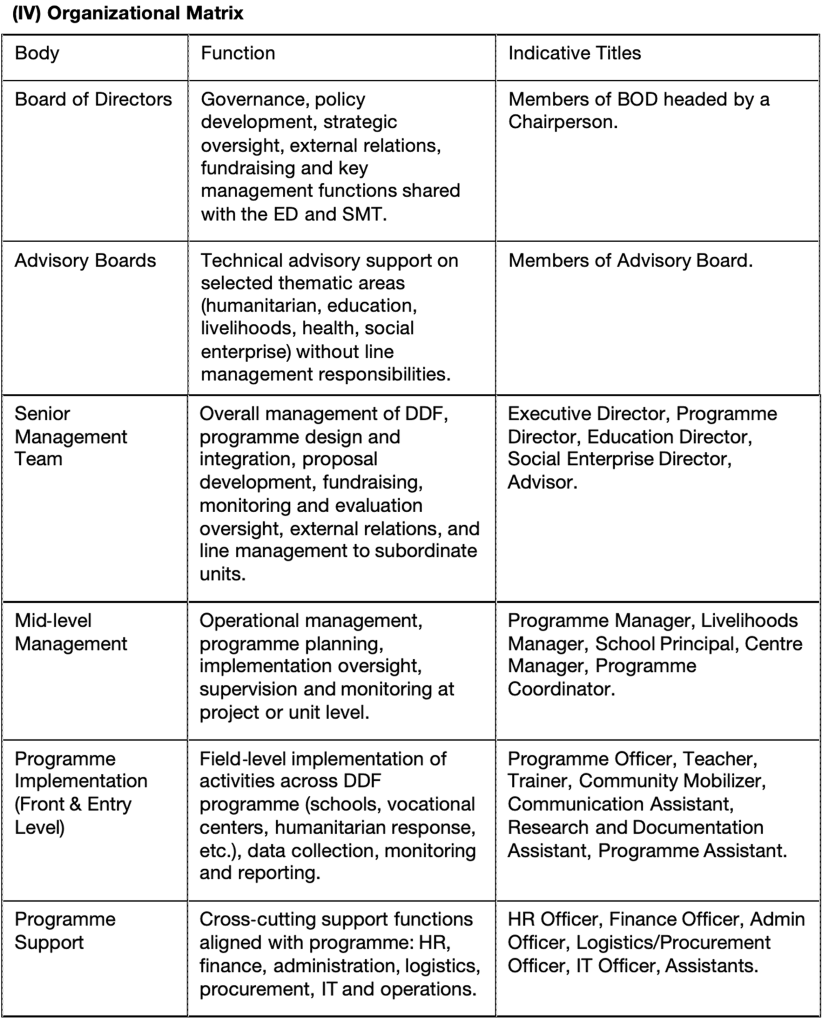
The Human Resources Manual is a guiding document that defines the relationship between Dreamland Development Foundation (DDF) and its staff members, including the Board of Directors, Advisory Board Members and Resource Pool Members. It ensures consistency, fairness, transparency and equal treatment for all staff, volunteers and governance bodies of DDF.
This manual supports DDF’s work across its core program areas:
 Humanitarian Assistance & Emergency ReliefLive
 Lihoods & Economic Empowerment
 Education & Human Capital Development
 Health & Community Well‑being (planned)
 Social Enterprise & Sustainability (planned) DDF’s core values guide all organizational decisions, staff conduct and HR policies.

Vision
A resilient and thriving Chin society where every person—especially children, youth, women and vulnerable groups—has access to protection, education, livelihoods and dignified opportunities to lead their own development.

Mission
Dreamland Development Foundation works to restore dignity and build long‑term resilience for conflict‑affected and marginalized communities by:
 · Delivering humanitarian assistance and emergency relief to internally displaced persons (IDPs), orphans, persons with disabilities and disaster‑affected households.
 · Providing livelihoods and economic empowerment through market‑relevant skills, vocational training and livelihood support.
 · Ensuring education and human capital development from kindergarten to community college level for displaced and local children and youth.
 · Developing health and community well‑being services through community‑based healthcare and psychosocial support (planned).
 · Establishing social enterprises and sustainable businesses that generate local income and subsidize core social services (planned).

Core Values of Dreamland Development Foundation
 · Integrity – DDF upholds honesty, transparency and strong moral principles in all programs, partnerships and internal processes.
 · Equality – DDF is committed to non‑discrimination and equal opportunity, especially for conflict‑affected, displaced and marginalized groups.
 · Humility – DDF works with empathy and respect, listening to communities and recognizing their agency and knowledge.
 · Accountability – DDF is accountable to the communities it serves, its staff, donors and partners, and integrates accountability mechanisms into all operations.
 · Transparancy – DDF is operating with anti-nepotism in HR and recruitment, openness and clarity in communication, decision making process, and resource management.
 · Do-No-Harm – DDF is committing to practices that prevent unintended vegative impacts on the people and community we serve.
 · Safeguarding – DDF is proactively protecting the health, well-being, and human rights of employees and beneficiaries, particulary children and vulnerable adults.
 · Environmental Sustability – DDF is integrating eco-friendly practive into daily operation to minimize our ecological footprint and preserve natural resources.

(II) Employment with Dreamland Development Foundation
Key Principles

DDF’s human resources management is based on:
 · Non‑discrimination, equality of opportunity and merit‑based decisions.
 · Zero tolerance for bribery, corruption, fraud and any form of exploitation.
 · Strong child safeguarding and protection of vulnerable adults; DDF does not tolerate any form of abuse, exploitation or harassment of beneficiaries, staff or partners.
 · Respect for confidentiality regarding recruitment information, performance evaluations and personal information, including health data.
DDF does not discriminate on the basis of gender, sexual orientation, religion, ethnicity, nationality, disability, age or any other status. All staff involved in recruitment and HR processes must fully understand and follow these principles.

Definition
A staff member of DDF is a person who has received a written confirmation of employment from the Executive Director for specific tasks defined in a Terms of Reference (ToR) and/or has signed a formal employment contract with DDF.

Type of Employment
Dreamland Development Foundation uses four main categories of engagement:

 · Full‑time staff – work a standard full working week as defined in their contracts.
 · Part‑time staff – work fewer hours than full‑time, as specified in their contracts.
&nbsp· Consultants – engaged for specific assignments, outputs or periods.
 · Volunteers – offer their time and skills without a full employment contract.
All categories must have written agreements with a clearly defined period of engagement, depending on organizational needs and funding availability. Full‑time staff are required to work 8 hours per working day; other categories work according to their agreements.

Workplace Diversity
Dreamland Development Foundation values and actively promotes diversity in its workforce. Diversity includes ethnicity, religion, nationality, age, gender, disability, displacement status, and other socio‑cultural characteristics. Dreamland Development Foundation particularly encourages the participation and leadership of women, youth, persons from conflict‑affected communities, and persons with disabilities in its staff structure. DDF will progressively increase the representation of women and under‑represented groups, especially in decision‑making and senior roles, while providing a flexible and inclusive working environment.

(III) Recruitment
Creation of a Position

A new position can be created only when:
 1.There is a clear programmatic or organizational need (e.g., scaling up humanitarian response, opening a new learning center, launching a social enterprise); and
 2.There is confirmed budget for this position from projects, unrestricted funds or earned income.

The relevant head of department or function (e.g., Programme Director, School Principal, Social Enterprise Manager) is responsible for proposing a new position. Once both conditions are met, a Recruitment Request Form is completed and signed by the responsible Director or Manager and forwarded to Finance/Administration to confirm budget availability and the correct budget line(s). After budget confirmation, the signed Recruitment Request Form is submitted to HR, which initiates the recruitment process and job advertisement. For newly created Director‑level or SMT positions, the Executive Director is the primary decision‑maker, subject to the same conditions above and with information to the BoD through written reports and meetings.

Hiring Manager
The head of the relevant department or unit normally acts as the Hiring Manager for the position under their supervision. As DDF grows, recruitment and decision‑making will be increasingly decentralized, with direct supervisors serving as Hiring Managers.
Recruitment of SMT positions (Directors, senior Advisors) is led by the Executive Director, while recruitment of specialized Advisors may be delegated to Directors, in consultation with the ED.

Job Description
A clear Job Description (JD) is mandatory for each position and must be drafted and regularly updated by the Hiring Manager. The JD follows DDF’s Standard Job Description Format and includes.
 · Brief profile of DDF and relevant program area (e.g., humanitarian, education, livelihoods).
 · Position title and reporting lines
 · Key responsibilities and tasks.
 · Required qualifications, skills and experience.
 · Alignment with DDF’s core values and safeguarding standards.
 · Application process and deadline.

Job Advertisement
Once a Recruitment Request Form is approved, the HR function prepares a job advertisement and posts it as soon as possible, ideally within two working days. Job advertisements are published via:
 · Dreamland Development Foundation website and social media pages (if available).
 · Relevant online job portals and professional networks.
 · Local notice boards and community networks where appropriate, especially in target communities.

Selection
Selection must be based on transparent, pre‑defined criteria agreed by the recruitment panel. The process includes four phases.

Phase 1 – Longlist
 · A designated HR focal person receives all applications.
 · The HR focal person prepares a Longlist using the Recruitment Tracker, based on basic eligibility (minimum requirements).
 · The Longlist is shared with the Hiring Manager.

Phase 2 – Shortlist

 · The Hiring Manager prepares a Shortlist of candidates based on the approved selection criteria (technical skills, experience with IDPs/education/livelihoods, language skills, etc.).
 · The number of shortlisted candidates should remain manageable within the recruitment timeline.
 · The Shortlist is sent back to HR to invite candidates to the next step.

Phase 3 – Interview / Written Test

 · HR and the Hiring Manager organize interviews at suitable times.
 · The recruitment panel typically includes: the Hiring Manager, an HR focal person, and at least one other relevant staff (e.g., program lead, school lead, or technical specialist).
 · A written test, practical task (e.g., teaching demo, case analysis, IT test) or presentation may be used depending on the position.

Phase 4 – Background Check & Job Offer

 · Candidates are ranked according to the selection criteria and overall performance.
 · Background checks with at least two referees are conducted before issuing any formal offer.
 · A written Offer Letter is issued to the most suitable candidate, including all key terms and conditions, and signed by the Hiring Manager and/or the Executive Director in line with DDF’s delegation of authority.

Probation Period
For contracts of 7–12 months and contracts longer than one year, the probation period is 3 months. During probation, either party may end the contract with two weeks’ notice. Staff who successfully complete probation become eligible for the benefits defined in this Manual.
For contracts shorter than one year:
 · 1–3 month contracts – probation period is 1 week.
 · 4–6 month contracts – probation period is 2 weeks.

Employment Confirmation
After successful completion of the probation period, an Employment Confirmation Letter is issued, confirming the staff member’s appointment and summarizing key terms and conditions of employment.

Volunteer
Volunteer recruitment follows a separate procedure aligned with DDF’s safeguarding and accountability standards. DDF practices blended volunteerism, engaging both local and (where feasible) international volunteers for technical exchange and networking.
DDF maintains a volunteer pool that can support all program areas, including education, livelihoods, humanitarian response, and social enterprise.
 · Allowances for volunteers under SMT management are defined in internal memos issued by the ED.
 · Allowances for volunteers working directly with BoD are defined in memos signed by the BoD Chairperson.
Volunteer titles reflect their scope of work and technical level (e.g., Community Education Volunteer, Livelihoods Volunteer Trainer).
During DDF’s growth phase, some staff may temporarily hold dual roles based on decisions by the ED and line managers. Such staff may be prioritized in salary allocation when resources are limited, but each staff member holds one primary position in the official structure.

(V) Responsibilities
All Staff

 · Read, sign and comply with this HR Manual and all supporting policies (e.g., Code of Conduct, Safeguarding, Anti‑Fraud).
 · Understand that lack of knowledge of policies is not an excuse for non‑compliance and may result in disciplinary action.
 · Seek clarification from their line manager or HR if any policy provisions are unclear.

Line Managers
 · Ensure their team members understand and comply with this HR Manual.
 · Provide coaching, feedback and guidance to support effective implementation of HR and organisational policies.
 · Consult with HR/OD in cases of non‑compliance to decide on appropriate and fair action.
 · Ensure that their team has easy access to the latest version of this Manual (printed or digital).

SMT Members
 · Monitor and review compliance with HR policies, standards and practices across DDF.
 · Provide strategic inputs to improve HR systems, including revisions to this Manual.

(VI) Remuneration
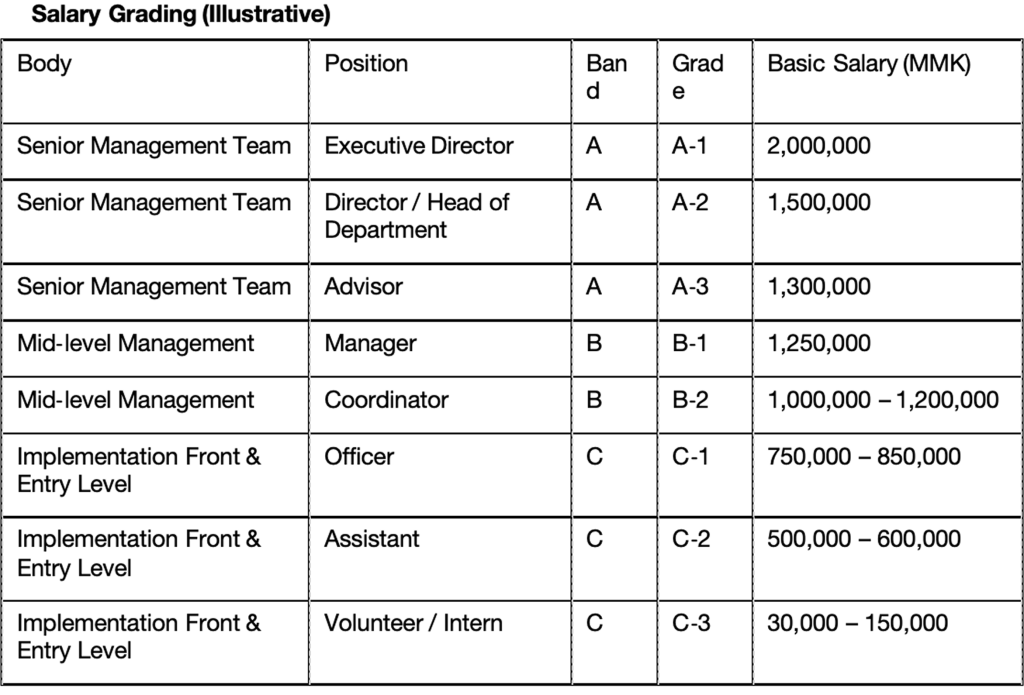
Members of the Board of Directors, Advisory Board and Resource Pool serve on a voluntary basis and are not paid salaries. They may receive reimbursement for transportation, communication, per diem and other work‑related expenses, subject to budget availability and internal rules.
All other Dreamland Development Foundation staff are remunerated according to a band and grade salary structure.
 · Salaries are generally set between the 50th and 75th percentile of comparable organizations in Myanmar, balancing competitiveness and financial sustainability.
 · The salary scale allows flexibility to reflect staff education, experience, performance and responsibility level.
 · Changes in salary structures and grading must be approved by the Executive Director.
 · Salaries do not increase automatically upon contract renewal; adjustments follow formal salary reviews informed by performance and organizational assessment.
Creation of new positions requires coordinated input from line managers, Finance and HR, and final approval by the ED.
Communication Cost & Per Diem
All Dreamland Development Foundation staff, including BoD, Advisory Board Members and Resource Pool Members, may receive communication and per diem allowances when performing work for DDF, subject to budget availability
 · For staff under SMT management, entitlements are defined by SMT and formalized in internal memos signed by the ED.
 · For BoD, Advisory and Resource Pool members, entitlements are defined only when necessary (for example, for unsponsored workshops that benefit DDF), and formalized through memos signed by the BoD Chairperson.
Actual work‑related expenses (travel, lodging, etc.) are reimbursed against valid receipts and in line with Dreamland Development Foundation’s finance policies.

(VII) Resignation / Termination
Resignation

All employees have the right to resign at their own initiative.
 · The standard notice period for one‑year fixed‑term contracts is one month.
 · For contracts shorter than one year, the notice period is mutually agreed and stated in the contract.
 · For contracts longer than one year, the notice period should be 3–6 months, subject to agreement and role criticality.

Termination
Dreamland Development Foundation may terminate a contract in four main situations:
 1. Contract end due to work or funding conditions – If project funding ends or organisational needs change, fixed‑term contracts may not be renewed. DDF will normally provide at least one month’s notice, where feasible.
 2. Correction – If a family relationship is formed (e.g., through marriage) between a Board member and Director or any one from Senior Management Team, one party must resign within 30 days.
 3. Displine – Violations may result in immediate removal from the Board or termination of employment.  (see Section 3)
 4. Misconduct or serious policy violations – If a staff member violates DDF’s core values, HR policies, safeguarding principles, or engages in serious inappropriate behaviour towards beneficiaries, staff or communities.
Progressive disciplinary action, including up to three warnings, may apply in some cases, but serious misconduct may justify immediate dismissal in line with applicable labour laws and DDF’s disciplinary procedures. Termination decisions in serious cases are taken in consultation between the BoD and ED.

(VIII) Leave
DDF recognizes the following types of leave for staff:

 · Study Leave – 5 days per year, (Special Study Leave to be discussed upon case).
 · Personal Leave – 5 days per year.
 · Sick Leave – 5 days per year.
 · Annual Leave – 10 days per year.

Unused Annual Leave can be carried over to the next year but must be taken within the first three months of that year; any remaining balance after this period expires automatically.
In the original manual, all leave types are unpaid; DDF may align this with Myanmar labour law and decide which types are paid or unpaid (e.g., paid sick and annual leave).


 · Staff must request leave from their supervisor at least one day in advance, verbally or in writing, except in emergencies or sudden sickness.
 · Unapproved days are considered absent days and salary is paid only for actual working days, according to contract terms.
 · Sick Leave can be taken for up to 3 consecutive days without medical documentation. For more than 3 consecutive days, a valid medical certificate from an authorized health professional is required.

(IX) Training and Professional Development
DDF is committed to the continuous professional growth of its staff, interns and volunteers.
 · Regular on‑the‑job training and capacity‑building sessions are organized by DDF leadership and technical teams, linked to humanitarian response, education quality, livelihoods, safeguarding and compliance.
 · Volunteers and interns may receive full or partial scholarships to join DDF’s paid training courses, vocational programs or other learning opportunities.
 · Staff, volunteers and interns can also benefit from capacity‑building offered through DDF’s national and international partnerships and networks.

(X) Amendment of this Manual
The authority to amend this HR Manual rests solely with the Board of Directors of Dreamland Development Foundation, as granted by DDF’s Articles of Association. The Board may exercise this right at any time as needed, without time limitation. As authorized by the Articles of Association, the Board of Directors of Dreamland Development Foundation hereby approves and signs this HR Manual on 1.1.2026.
1. Introduction
Dreamland Development Foundation (DDF) works closely with children and young people through its humanitarian, education, livelihoods and community programmes. DDF recognizes that all children have the right to be protected from all forms of abuse, neglect, exploitation and violence, and that the organization has a special duty of care towards children with whom it works directly or indirectly.
This Child Protection Policy sets out DDF’s commitments, principles, standards and procedures to prevent harm to children and to respond appropriately when concerns arise. It applies to all settings where DDF operates, including learning centers, community activities, field locations, offices, transit points and online platforms.

2. Purpose and Scope The purpose of this policy is to:
 · Protect the rights, safety and wellbeing of children who are reached by DDF’s programmes and activities.
 · Ensure that all people associated with DDF understand their responsibilities to prevent, identify and report child abuse and exploitation.
 · Establish clear procedures for safe recruitment, safe behaviour, reporting and responding to child protection concerns.

This policy applies to:
 · All Dreamland Development Foundation staff (fulltime, parttime, fixedterm, probationary).
 · All volunteers, interns and shortterm workers.
 · All consultants, trainers and resource persons engaged by DDF.
 · All members of the Board of Directors and Advisory Board when acting on behalf of Dreamland Development Foundation.
 · Partners, contractors and other third parties when they are working with or on behalf of Dreamland Development Foundation and have contact with children.

Compliance with this policy is a mandatory condition for working with DDF.

3. Guiding Principles
Dreamland Development Foundation’s Child Protection Policy is guided by:
 · Best interests of the child – In all decisions and actions concerning children, the best interests of the child are a primary consideration.
 · Zero tolerance – DDF does not tolerate any form of child abuse, exploitation, neglect or violence. No level of abusive or exploitative behaviour is acceptable.
 · Nondiscrimination – All children are treated with equal respect and dignity, regardless of gender, disability, ethnicity, religion, nationality, displacement status or any other characteristic.
 · Participation – Children are listened to, and their views are given due weight in decisions that affect them, in a manner appropriate to their age and maturity.
 · Confidentiality and safety – Concerns and reports are handled confidentially, with information shared only on a needtoknow basis, and with priority given to the safety of the child and those who report.
 · Do no harm – All programmes and decisions must consider and minimize potential risks to children, including unintended consequences.

4. Definitions
For the purposes of this policy:
 · Child: Any person under the age of 18 years, regardless of local norms or definitions.
 · Child abuse: All forms of physical and/or emotional illtreatment, sexual abuse, neglect or negligent treatment, commercial or other exploitation, resulting in actual or potential harm to the child’s health, survival, development or dignity.
 · Physical abuse: Any act that causes actual or potential physical harm to a child, including hitting, beating, shaking, burning, poisoning or other physical harm.
 · Emotional/psychological abuse: Persistent emotional maltreatment that adversely affects a child’s emotional development, such as verbal abuse, humiliation, threats, rejection, isolation or exposure to violence.
 · Sexual abuse: Any actual or threatened sexual activity with a child, including contact and noncontact activities, where the child cannot give informed consent or is coerced, manipulated or forced.
 · Exploitation: Using a child for someone else’s advantage, gratification or profit, including child labour, sexual exploitation, trafficking, forced marriage or recruitment into armed groups.
 · Neglect: Persistent failure to provide for a child’s basic physical and/or emotional needs, likely to result in serious impairment of the child’s health or development.
 · Child safeguarding: All measures taken to prevent and respond to abuse, exploitation, neglect and violence against children in DDF’s programmes and operations.

5. Dreamland Development Foundation’s Commitment to Child Protection
Dreamland Development Foundation’s commits to:
 · Maintain a childsafe environment in all programmes, offices and activities.
 · Integrate child protection considerations into the design, implementation, monitoring and evaluation of all programmes (humanitarian, education, livelihoods, health, social enterprise).
 · Prevent persons who pose a risk to children from being recruited or engaged by DDF.
 · Ensure that all staff and representatives know how to recognize, prevent and report child protection concerns.
 · Take all concerns and allegations seriously and respond promptly, fairly and in line with national laws and good practice.
 · Work, when appropriate and safe, with families, communities, service providers and authorities to protect children and support their wellbeing.

6. Roles and Responsibilities
 · Board of Directors
 · Approves and periodically reviews the Child Protection Policy.
 · Ensures that child protection is integrated into Dreamland Development Foundation’s overall governance and risk management.
 · Executive Director (ED)
 · Has overall responsibility for implementation of this policy throughout DDF.
 · Ensures that adequate resources, procedures and focal points are in place to support child protection.
 · Child Protection Focal Point(s) (can be assigned at central and field level)
 · Act as primary contacts for receiving and managing child protection concerns within Dreamland Development Foundation.
 · Provide guidance to staff on applying this policy and escalate cases to the ED and/or relevant authorities as needed.
 · Maintain secure and confidential records of all reported cases.
 · Senior Management Team (SMT)
 · Ensure that child protection measures are embedded in programmes and operations under their supervision.
 · Support training and awareness raising for staff and partners.
 · Human Resources
 · Integrate child protection into recruitment, induction, performance management and disciplinary procedures.
 · Ensure that contracts and job descriptions include child protection responsibilities where relevant.
 · All Staff, Volunteers, Interns, Consultants and Board Members
 · Read, understand and sign DDF’s Child Protection Policy and Code of Conduct.
 · Adhere to the behavioural standards outlined in this policy at all times.
 · Immediately report any concerns or suspicions regarding possible child abuse or risk.

7. Safe Recruitment and Screening
To reduce the risk of child abuse by people working with or for DDF, the organization will:
 · Use recruitment processes that clearly state DDF’s commitment to child protection (e.g., in job advertisements, interviews, reference checks).
 · Require applicants for positions involving contact with children to:
 · Provide at least two references, including at least one from a recent employer.
 · Declare any previous criminal convictions or ongoing investigations related to children, violence or sexual offences.
 · Conduct reference checks that specifically ask about suitability to work with children, as feasible and safe.
 · Include child protection responsibilities, expectations and consequences of breaches in contracts and ToRs.
 · Reserve the right to refuse employment or engagement, or to terminate contracts, for individuals who may pose a risk to children or who have violated child protection standards.

8. Behavioural Standards (Code of Conduct)
All individuals covered by this policy must follow these minimum standards of behaviour when interacting with children:
They must:
 · Treat children with respect, dignity and fairness at all times.
 · Listen to children and take their views seriously, in ways appropriate to their age and understanding.
 · Ensure that activities with children are carried out in safe, open and accountable environments.
 · Use positive, nonviolent methods of communication and discipline; encourage good behaviour through support and guidance.
 · Immediately report any concerns, suspicions or disclosures of abuse or exploitation involving children.
 · Respect the privacy and confidentiality of children and their families, sharing information only with those who need to know for safety reasons.
They must not:
 · Hit, physically punish or emotionally abuse a child.
 · Engage in any form of sexual activity with a child, including grooming, suggestive language, sexual jokes or any physical contact of a sexual nature.
 · Develop relationships with children that could be seen as exploitative or abusive, including favouritism or “special” treatment (e.g., excessive gifts, private meetings, secret communication).
 · Be alone with a child in a private or unobservable space, unless absolutely necessary and where another adult is nearby and aware.
 · Take children to their private home or accommodation, or invite children to stay overnight, without appropriate approval and safeguards.
 · Take photos, videos or audio recordings of children or share their information (including online) without proper consent and a clear, safe purpose.
 · Use computers, phones or any digital device to access, store, display, distribute or create child sexual abuse materials or any content that exploits children.
 · Consume alcohol or drugs in a manner that may impair judgement or behaviour while responsible for or in contact with children.
Breaches of these standards are treated as serious misconduct and may lead to disciplinary action, including dismissal and referral to authorities where appropriate.

9. Working with Partners and Third Parties
Where DDF works through or with partner organizations, schools, churches, community groups, suppliers or contractors who may have contact with children:
 · DDF will inform them of its Child Protection Policy and share minimum standards.
 · DDF will encourage and, where possible, require partners to have their own child protection/safeguarding policies that meet or exceed DDF’s standards.
 · Agreements (MoUs, contracts) with partners and service providers will, where relevant, include clauses on child protection responsibilities and the consequences of breaches.

10. Communication, Media and Data Protection
When collecting, using and sharing information, images or stories about children:
 · DDF will obtain informed consent from the child and, where appropriate, their parent/guardian before taking or using photos, videos or personal stories.
 · DDF will not publish or share information that could reveal the identity or location of a child and put them at risk (e.g., full names, exact addresses, school name, detailed location).
 · Images and stories will show children in a dignified and respectful way, not as helpless victims.
 · All digital and physical records containing personal or sensitive information about children will be stored securely and accessed only by authorized staff.

11. Reporting Child Protection Concerns
All staff and representatives have a duty to report any:
 · Concern or suspicion that a child may be at risk or has been harmed;
 · Observation of staff, volunteer, partner or community behaviour that may be abusive or unsafe;
 · Disclosure from a child or adult regarding possible abuse, exploitation or neglect.
Reports should be made immediately or as soon as possible and must not be delayed.
How to Report
 · First point of contact: DDF’s Child Protection Focal Point or line manager.
 · If the concern involves the line manager, report directly to the Child Protection Focal Point or the Executive Director.
 · If the concern involves senior management or there is fear of retaliation, staff can report directly to the Board Chair or through any designated confidential reporting channel (bawiliankhum@ddfmyanmar.com or hotline info@ddfmyanmar). At the time of reporting, the person should provide:
 · Name and contact details (unless reporting anonymously).
 · Name or description of the child(ren) involved, if known.
 · Description of the concern or incident (what happened, when, where, who was involved).
 · Any immediate risks to the child’s safety. No one should conduct a full investigation on their own. Their responsibility is to report, not to prove that abuse has occurred.

12. Responding to Child Protection Concerns
Upon receiving a report:
 1. The Child Protection Focal Point (or ED, where necessary) will make an initial assessment of the information and immediate risks.
 2. The safety and wellbeing of the child will be the first priority; immediate protective actions may include removing a staff member from contact with children or adjusting activities.
 3. If the allegation involves possible criminal conduct, or if the child is in immediate danger, DDF will, where safe and in line with local law and context, consider referring the matter to appropriate authorities or specialized child protection agencies.
 4. Internal procedures may include:
 · Documenting the concern in a secure incident report form.
 · Interviewing the reporter and, if appropriate and safe, the child and relevant witnesses (using childfriendly approaches).
 · Consulting with SMT and, where needed, the Board.
 5. Where the alleged perpetrator is a DDF staff member, volunteer, consultant or Board member, DDF will consider immediate suspension or restriction of duties while the concern is assessed. Disciplinary procedures may result in warnings, termination of contract and, where relevant, referral to authorities.
 6. DDF will seek to provide or facilitate access to appropriate support services for the affected child (e.g., medical care, psychosocial support, safe accommodation), taking into account the wishes and best interests of the child. Retaliation against any person who, in good faith, reports a concern is strictly prohibited.

13. Training and Awareness
DDF will ensure that:
 · All new staff, volunteers, interns and relevant partners receive orientation on this Child Protection Policy and sign the Child Protection Code of Conduct as part of their induction.
 · Existing staff receive regular refresher training (at least every two years or as appropriate) on child protection, reporting procedures and safe behaviour.
 · Managers and focal points receive additional training on handling disclosures, complaints and investigations in a childsensitive manner.
 · Childappropriate information about their rights and available complaint mechanisms is shared with children involved in DDF programmes, where feasible and safe.

14. Risk Assessment and Programme Design
Programme managers and teams will:
 · Integrate child protection risk assessments into programme design, implementation and monitoring.
 · Identify activities that may pose higher risks to children (e.g., residential activities, transport, onetoone tutoring, online learning) and put in place extra safeguards (e.g., additional supervision, consent forms, stafftochild ratios).
 · Review procedures regularly to ensure risks are minimized and mitigation measures remain effective.

15. Confidentiality, RecordKeeping and Data Protection
 · All reports, records and documentation related to child protection concerns will be stored securely (locked cabinet or passwordprotected files) with access limited to authorized persons.
 · Information will be shared only on a strict needtoknow basis for responding to the concern, protecting the child and fulfilling legal obligations.
 · Personal data about children and staff will be handled in line with DDF’s confidentiality and data protection standards.

16. Breaches of the Policy
Any breach of this Child Protection Policy or the Child Protection Code of Conduct by a staff member, volunteer, intern, consultant or Board member may result in disciplinary action, including:
 · Verbal or written warning.
 · Suspension from duties, with or without pay.
 · Termination of employment or engagement.
 · Reporting to relevant authorities, professional bodies or other organizations, as appropriate.
Where a partner organization or contractor fails to meet agreed child protection standards, Dreamland Development Foundation may suspend or terminate the partnership or contract.

17. Policy Review and Amendment
This Child Protection Policy will be reviewed at least every three years, or sooner if there are significant changes in DDF’s programmes, legal context or learning from practice. The Board of Directors has the authority to approve amendments. The Board of Directors of Dreamland Development Foundation hereby adopts this Child Protection Policy on this 1 day of January 2026.

1. Purpose and Scope
This Financial Management and Procurement Policy provide the framework for how Dreamland Development Foundation (DDF) manages its funds and resources in a transparent, accountable and efficient manner. It supports DDF’s mission across its humanitarian, education, livelihood, health and social enterprise programmes.
The policy applies to:
 · All Dreamland Development Foundation staff (fulltime, parttime, temporary).
 · All volunteers and interns involved in financial or procurement processes.
 · All consultants, Board members and other representatives when acting on behalf of Dreamland Development Foundation.
 · Suppliers, service providers and implementing partners engaged with DDF funds.
*Compliance with this policy is mandatory.

2. Definitions
Interested Person: Any Board member, officer, or member of a committee with Board delegated powers, or any member of Top Management. Immediate Family: Includes spouse, domestic partner, parents, children, siblings, and in-laws.
Related Party Transaction: Any contract or deal between the NGO and a family member of a decision-maker.

3. Principles of Financial Management
Dreamland Development Foundation’s financial management is guided by the following principles:
 · Stewardship – DDF uses all funds solely to advance its mission and the agreed objectives of donors and communities.
 · Transparency – Financial information and decisions are documented, traceable and available to relevant stakeholders.
 · Accountability – Staff and management are responsible for the proper use of funds and adherence to policies, contracts and donor conditions.
 · Integrity and zero tolerance for fraud and corruption – Any form of fraud, misuse of funds, bribery or conflict of interest is prohibited.
 · Compliance – DDF complies with applicable laws, donor regulations, and its own internal policies.
 · Segregation of duties – No single person controls all steps of a financial transaction; responsibilities are divided to prevent errors and abuse.
 · Prohibited Pairings – A husband and wife, or any two immediated family members shall not be authorized as Joint signatories on the same bank account.
 · Approval Levels – No family member may approve a purchase request, expense claim, or salary payment for another family member.

4. Roles and Responsibilities
· Board of Directors (BoD)
 o Approves the overall financial policy and annual organizational budget.
 o Reviews financial reports and audit findings and ensures corrective actions.
· Executive Director (ED)
 o Has overall responsibility for implementing financial and procurement policies.
 o Approves major financial commitments within delegated authority and donor rules.
· Senior Management Team (SMT)
 o Ensure financial procedures are integrated into programme planning and implementation.
 o Reviews budget vs. actual reports and takes corrective measures.
· Finance Manager / Finance Officer (if titled differently, adjust)
 o Manage daytoday financial operations, accounting records and bank relations.
 o Prepare financial reports, cash flow forecasts and supports budgeting.​
 o Ensures compliance with this policy, donor requirements and audit recommendations.
· Programme Managers / Project Coordinators
 o Develop and manage project budgets in line with approved work plans.
 o Ensure expenditures are allowable, properly documented and within budget limits.
· All Staff and Volunteers
 o Follow financial and procurement procedures when handling DDF funds or assets.
 o Immediately report suspected irregularities, fraud or policy breaches.

5. Budgeting and Planning
 · DDF prepares an annual organizational budget that consolidates all programme and core costs for the financial year.
 · Project budgets are developed based on approved work plans and donor agreements and must be consistent with DDF’s chart of accounts.
 · Budgets are reviewed and approved by SMT and then by the BoD (or delegated committee), and may be revised during the year if new grants are received or conditions change.
 · Programme Managers are responsible for monitoring their budgets and ensuring that expenditure remains within approved limits.

6. Accounting and RecordKeeping
 · DDF maintains accurate, complete and uptodate accounting records for all financial transactions, using a standardized chart of accounts.
 · All transactions must be supported by original documentation (invoices, receipts, contracts, timesheets, payment vouchers, bank slips).
 · Financial records are kept in an orderly filing system (physical and/or electronic) and retained for the period required by law and donors (typically at least 5–7 years).
 · All project and organizational accounts are subject to regular internal review and external audit, as required by donors and regulations.

7. Bank and Cash Management
7.1 Bank Accounts

 · Dreamland Development Foundation operates bank accounts in the name of Dreamland Development Foundation, not in the name of individuals.
 · The BoD approves the opening and closing of bank accounts.
 · Signatory rules are set so that at least two authorized signatories are required for each bank transaction, usually a combination of ED/SMT and Finance.​ (see Section 3)
 · Bank statements are obtained regularly and reconciled with the accounting records each month.
7.2 Cash Management
 · Cash on hand is kept to a strict minimum necessary for small, daytoday transactions.
 · A petty cash system is used with a fixed ceiling and clear replenishment procedures.
 · All cash movements (receipts and payments) are recorded daily in a cash book and supported by signed vouchers.
 · Periodic cash counts are conducted by Finance and at least one other staff member, and any discrepancies are investigated immediately.
7.3 Payments
 · Payments should preferably be made by bank transfer. Cash payments are allowed only when bank transfer is not practical (e.g., in remote areas).
· All payments require:
 o Verified supporting documents must be reviewed and signed by Board member or senior officer who is unrelated to the staff member on payroll (invoice, contract, purchase order).
 o Evidence of receipt of goods/services.
 o Approval by authorized staff according to the authorization matrix.
· Personal bank accounts must not be used for receiving or holding DDF funds, except under preapproved mechanisms (e.g., field advances or certain condition) and with proper documentation.

8. Income Management
 · All income (donor funds, fees, social enterprise revenue, donations) is promptly recorded in the accounting system, with clear allocation to the correct project and account.
 · Donor funds must be used only for the purposes and within the time frames agreed in the grant agreement.
 · Any interest earned on donor funds is handled in accordance with donor contracts.
 · DDF may charge reasonable indirect/overhead costs on grant budgets to cover shared organizational expenses, where allowed by donors.

9. Financial Reporting and Audit
 · Regular internal financial reports (e.g., monthly/quarterly) compare budget vs. actual expenditure and are shared with Programme Managers, SMT and BoD as appropriate.
 · Donor financial reports are prepared according to each donor’s format, currency, reporting period and rules, and submitted on time with supporting documentation.
 · DDF’s accounts are subject to annual external audit, commissioned by the BoD.
 · Audit recommendations are reviewed by management and BoD, and an action plan is implemented and monitored.

10. Advances and Reconciliation
 · Staff may receive advances for approved activities (e.g., field visits, trainings, community events) based on approved budgets and work plans.
 · Each advance must be supported by an advance request form, approved by the relevant manager and Finance.
 · Advances must be accounted for within a defined period (e.g., 7–14 days after completion of the activity) with full receipts and a signed liquidation form.
 · No new advance is given to a staff member who has not cleared up a previous advance.

11. Asset and Inventory Management
 · All significant assets (e.g., vehicles, computers, equipment, furniture) purchased with DDF or donor funds are recorded in an asset register with details of location, custodian and condition.
 · Inventories of consumable supplies (e.g., office supplies, teaching materials, relief items) are maintained and periodically verified.
 · Assets are used only for official DDF purposes and must not be taken for private use without explicit authorization.
 · Disposal or transfer of assets follows donor rules and is approved by management and, where required, the BoD.

12. Fraud, Corruption and Conflict of Interest
 · DDF has zero tolerance for fraud, corruption, theft, embezzlement, bribery or any other misuse of funds.
 · Staff must not solicit, accept or offer bribes, kickbacks or other improper benefits in relation to DDF business.
 · Any suspected fraud or irregularity must be reported immediately to the ED, Finance Manager or BoD (or to a dedicated reporting mechanism if available).
 · Conflicts of interest (e.g., a staff member selecting a supplier owned by a family member) must be declared and appropriately managed; staff with a conflict of interest must recuse themselves from related decisions.

13. Procurement Policy
13.1 Objectives and Scope

The procurement policy ensures that all goods, works and services required by DDF are acquired:
 · In a transparent, fair and competitive manner.
 · At the best value for money, considering quality, cost, reliability and ethical standards.
 · In compliance with donor requirements and applicable laws. This policy covers all purchases funded by DDF or its donors, including humanitarian supplies, school materials, construction, consultancy services and operational goods.
13.2 Procurement Principles
 · Value for money – best combination of quality, cost, reliability and timeliness.
 · Fair competition – suppliers are treated fairly and given reasonable opportunity to compete.
 · Transparency – procurement decisions are well documented and justifiable.
 · Accountability – roles and decisionmaking authority are clearly defined.
 · Integrity – procurement is free from undue influence, favoritism and conflicts of interest.
13.3 Roles and Responsibilities in Procurement
· Procurement/Logistics Officer (or designated staff)
 o Manages daytoday procurement processes and documentation.
 o Ensures compliance with thresholds, methods and donor rules.
· Programme/Department Staff
 o Identify needs, prepare specifications, and initiate purchase requests.
 o Verify receipt and quality of goods and services.
· Finance
 o Confirms budget availability before commitments are made.
 o Ensures that payments match approved procurement documents.
· Procurement Committee (for highervalue purchases)
 o Reviews quotations, bids and evaluations; recommends supplier selection.
 o Ensures fairness and transparency for significant procurements.

14. Procurement Thresholds and Methods
Dreamland Development Foundation will set monetary thresholds (to be adjusted by management and BoD from time to time) that determine procurement methods, for example:

· Petty Purchases (under 5,000,000 MMK)
 o Single quotation is sufficient; documented in a petty cash voucher or simple purchase form.
· Small Purchases (5,000,001 to 10,000,000 MMK)
 o At least two or three written quotations from different suppliers (email, proforma, written quote).
 o Comparison recorded on a quotation comparison sheet and approved by the relevant manager.
· Large Purchases (above 10,000,001 MMK or donordefined thresholds)
 o Formal competitive processes, such as Request for Quotation (RFQ) or Request for Proposal (RFP).
 o Public or targeted invitation to suppliers, clear specifications and evaluation criteria.
 o Evaluation by a procurement committee, with minutes and recommendation. o Contract or purchase order issued to the selected supplier.

15. Procurement Process Steps
A typical procurement process includes:
1. Needs Identification and Specification

 o Programme/department identifies need and prepares clear specifications (quantity, quality, delivery time, location).
2. Purchase Request
 o A purchase requisition form is completed and approved by the authorized manager and Finance (budget check).
3. Selection of Procurement Method
 o Based on thresholds and donor rules, choose petty purchase, simple quotation, or competitive bidding.
4. Soliciting Quotations/Bids
 o Obtain required number of quotations or issue RFQ/RFP with clear instructions and deadlines.
5. Evaluation and Selection
 o Compare quotations/bids using preagreed criteria (price, quality, delivery, aftersales service, reliability).
 o Document the evaluation and selection decision (e.g., bid evaluation form).
6. Approval and Contracting
 o Obtain approval from authorized signatories as per the authorization matrix.
 o Issue a Purchase Order (PO) or contract that states terms and conditions (price, delivery, payment, warranty).
7. Delivery and Receipt
 o Confirm that goods/services received match the order (quantity, quality, specifications).
 o Record receipt on a Goods Received Note (GRN) or service completion report, signed by the relevant staff.
8. Payment
 o Finance processes payment only after verifying that documentation is complete (PR, PO/contract, Invoice, GRN, approvals).
 o Payment is made according to agreed terms (e.g., within 30 days).
9. Filing and RecordKeeping
 o All procurement records are filed by procurement reference number and retained for audit and donor review.

16. Emergency Procurement
In genuine emergencies (e.g., rapid humanitarian response where delays could endanger lives or cause significant harm):
 · Dreamland Development Foundation may apply simplified or accelerated procurement procedures, while still seeking best value and clear documentation.
 · Emergency procurement must be justified in writing, approved by management and, where required, later regularized and reported to donors.

17. Environmental and Ethical Considerations
 · Where possible, Dreamland Development Foundation will prefer suppliers and products that minimize negative environmental impact (e.g., durable goods, reduced plastic, energyefficient equipment).
 · Dreamland Development Foundation will avoid suppliers known to be involved in child labour, forced labour, illegal activities or serious human rights abuses.
 · For social enterprise activities, Dreamland Development Foundation will align procurement decisions with its social and environmental objectives.

18. Policy Breaches and Sanctions
Breaches of the Financial Management and Procurement Policy, including fraud, bribery, misappropriation, serious negligence or ignoring procurement rules, may result in:
 · Verbal or written warning.
 · Reassignment or suspension of duties.
 · Termination of employment or engagement.
 · Recovery of misused funds where possible.
 · Reporting to relevant authorities or donors as appropriate. Where suppliers or partners violate agreed financial or procurement standards, Dreamland Development Foundation may suspend or terminate the contract or partnership.

19. Review and Amendment
This Financial Management and Procurement Policy will be reviewed at least every three years, or earlier if required by significant changes in DDF’s operations, donor requirements or legal context. Any amendments must be approved by the Board of Directors.

The Declaration of Conflict of Interest Form is required to be completed by all staff, board members, and key volunteers annually. Download the form below, complete it, and submit it to the HR department.

All procurement activities require the use of official DDF procurement forms to ensure compliance with our Financial Management & Procurement Policy. Download the complete set of procurement forms below.

“Learn to do right; seek justice. Defend the oppressed.”
(Bible)